
A Beginner’s Guide to NPAs
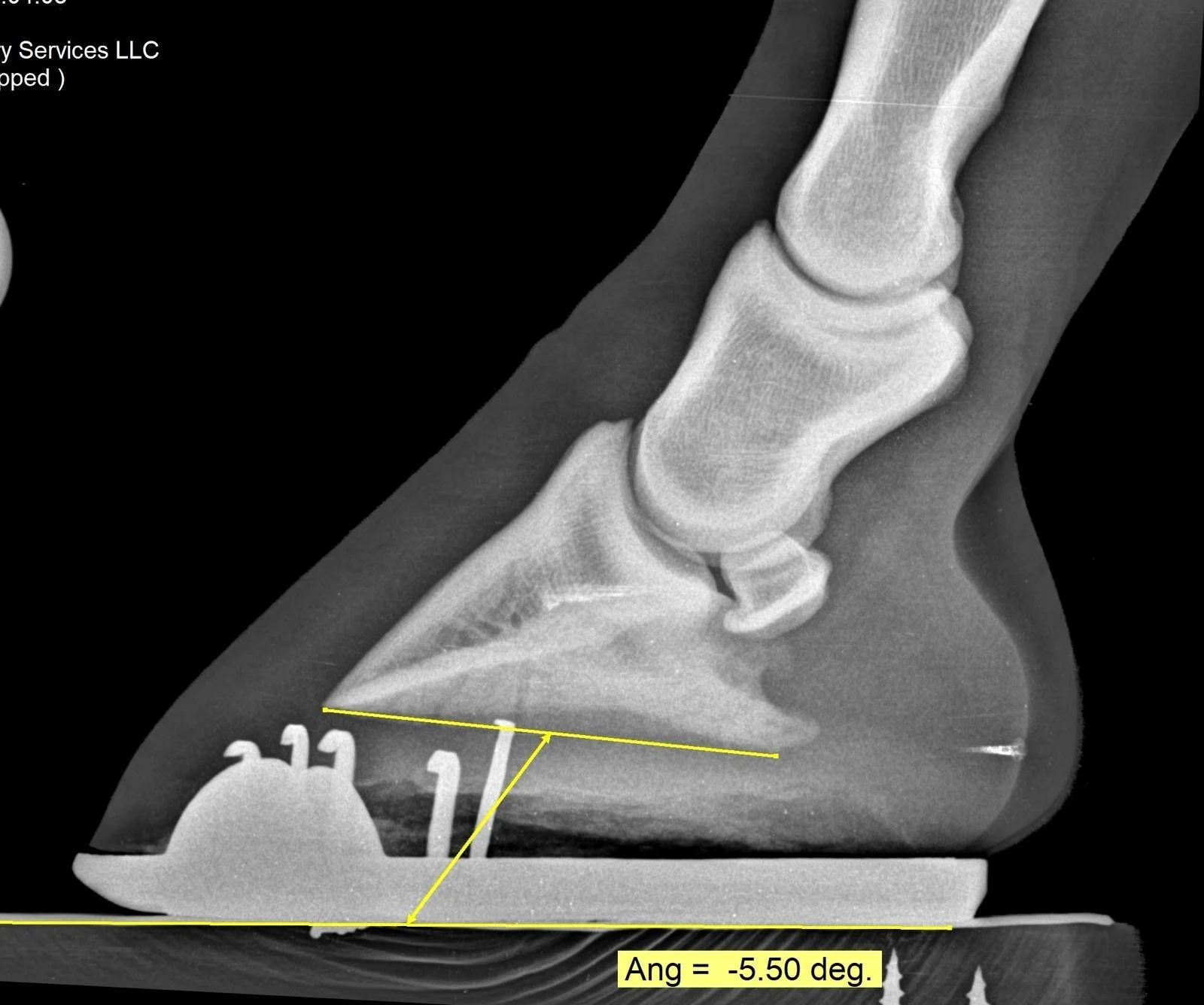
*Not a client’s horse
Negative palmar and plantar angles — usually shortened to NPA — sound much more complicated than they need to be.
At its simplest, NPA means that the coffin bone inside the hoof is sitting at an unfavorable angle, with the back of the bone sitting lower than the front.
Because the coffin bone sits inside the hoof capsule, we can't actually see its position just by picking up the foot. We can see clues on the outside, but radiographs (X-rays) are how we confirm what is happening inside.
First, What Is the Coffin Bone?
Inside every hoof is a bone called the coffin bone, also known as P3 or the distal phalanx.
It is essentially the main bone inside the hoof capsule.
When we look at the hoof from the side, the bottom edge of the coffin bone normally isn't perfectly parallel with the ground.
The back of the bone generally sits slightly higher than the front.
Think of it as a very slight downhill slope toward the toe.
When the back of the coffin bone drops below the front, that slope reverses.
That's a negative angle.
Palmar vs. Plantar — What's the Difference?
Thankfully, this part is easy.
Palmar = front feet.
Plantar = hind feet.
So:
Negative Palmar Angle (NPA) = a negative coffin-bone angle in a front hoof.
Negative Plantar Angle (NPA) = a negative coffin-bone angle in a hind hoof.
You'll commonly see both shortened to NPA.
What Does an NPA Hoof Look Like?
This is where things get a little tricky.
You cannot confirm NPA just by looking at a hoof.
The coffin bone is inside the foot, so the only way to actually know its angle is with a correctly taken lateral radiograph.
However, the outside of the hoof can give us clues.
Things that may make a hoof-care provider or veterinarian suspicious include:
low or underrun heels
a long or distorted toe
heels that appear pushed forward
a hoof-pastern angle that appears "broken back"
a bullnosed toe, especially in the hind feet
a horse that consistently stands with its hind legs underneath its body
None of these automatically mean a horse has NPA.
They're simply reasons to look a little closer.
Research comparing external hoof measurements with radiographs supports this distinction: what we see on the outside doesn't always accurately predict the position of the coffin bone inside.
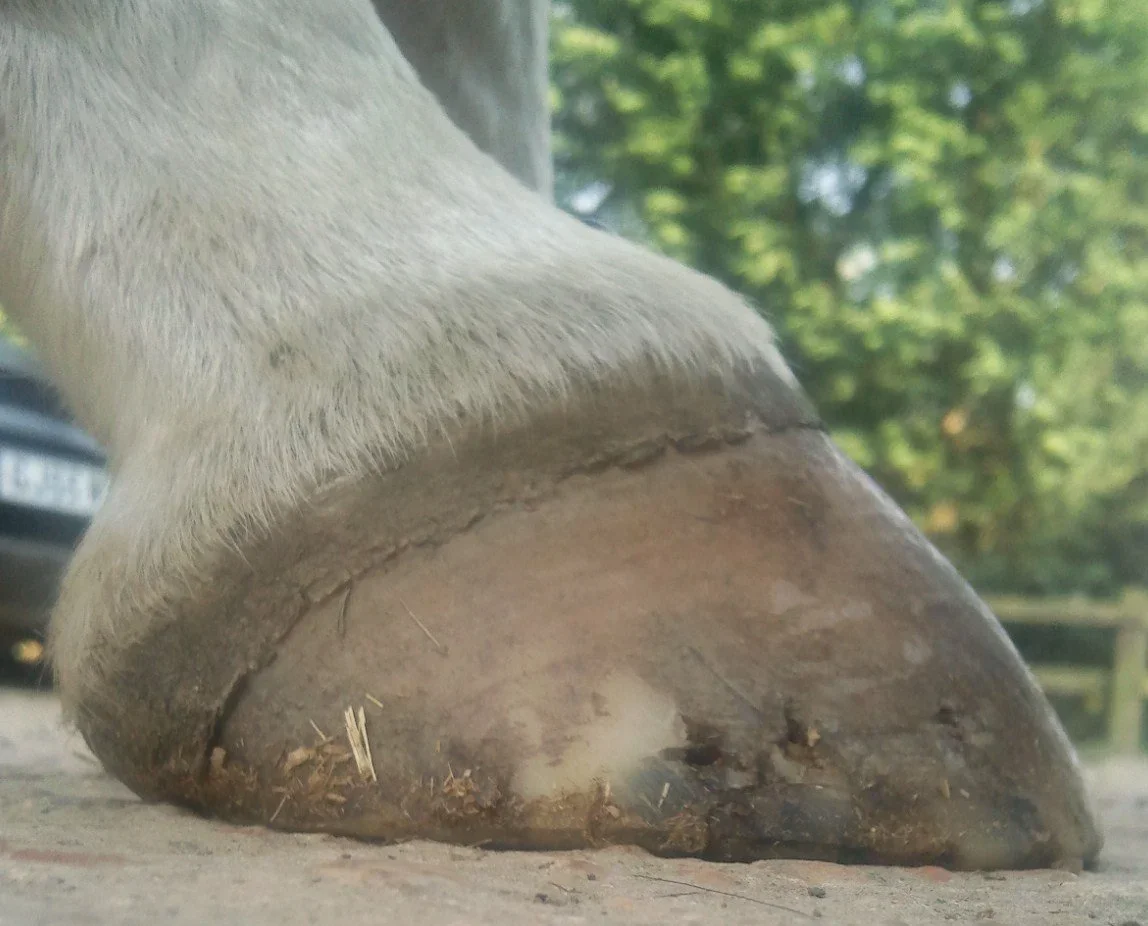
What Is a Bullnosed Hoof?
This is one of the more recognizable shapes owners may notice, particularly in hind feet.
Looking at a normal hoof from the side, the front hoof wall should generally follow a fairly straight line down toward the ground.
With a bullnosed hoof, the front wall develops a rounded or outward-curving appearance.
It can make the toe look rounded, bulging or almost "pushed out."
A bullnose is often associated with abnormal hind-hoof balance and can be a clue that makes us suspicious of a negative plantar angle.
Why Do Negative Angles Matter?
The hoof is the horse's foundation. The bones, joints, tendons, and ligaments of the limb all have to function above that foundation. If the orientation of the hoof changes, the way forces travel through the foot and limb changes too.
One important structure is the deep digital flexor tendon (DDFT). The DDFT travels down the back of the leg, around the navicular region, and attaches to the underside of the coffin bone.
Research has shown that hoof conformation and heel elevation can influence the forces acting on these structures. [2,3]
That does not mean:
NPA = tendon injury.
And it doesn't mean every horse with an NPA is lame.
It simply means that hoof balance affects more than the appearance of the foot.
What About the Hind Feet?
Negative plantar angles in the hind feet are especially interesting because they may be associated with changes in how a horse stands.
Some horses with low or negative plantar angles stand with their hind legs farther underneath their body.
You might hear this described as "camped under."
Instead of the hind limbs standing comfortably beneath the horse, the horse may appear to tuck them forward under the belly.
Research looking at horses with negative plantar angles found that changing the balance of the hind feet resulted in measurable changes in hind-limb posture. [4]
That doesn't mean every horse standing underneath itself has an NPA.
Posture can be influenced by many things.
But it does remind us that the hoof and the rest of the horse are connected.
Can't We Just Raise the Heel?
It sounds logical.
If the back of the coffin bone is too low, why not just raise it?
Sometimes temporary heel elevation may be part of a veterinarian and hoof-care provider's plan. Boots, pads, wedges or other forms of support may be useful depending on the individual horse.
But simply making the heel taller doesn't necessarily create a healthier heel.
A hoof may also be dealing with:
underrun or crushed heel structures
a stretched-forward hoof capsule
excessive toe length or leverage
poor development in the back of the foot
inadequate sole depth
uneven loading
Those things take time to improve.
The goal isn't to make the hoof look correct in one trim.
The goal is to grow a healthier hoof.
Can a Barefoot Horse Have NPA?
Yes.
Being barefoot doesn't automatically mean a hoof is balanced. A barefoot horse can still have a long toe, underrun heels, weak structures in the back of the foot, poor sole depth or an unfavorable coffin-bone orientation.
Likewise, seeing NPA doesn't automatically mean a horse needs shoes.
Management depends on the individual horse.
That may include appropriate trimming, hoof boots, pads or other temporary protection, changes in footing, comfortable movement and addressing nutrition or management factors that affect hoof growth.
How Is NPA Corrected?
Usually, gradually.
A hoof grows from the coronary band downward. We can't instantly replace distorted hoof with healthy new growth.
Depending on the horse, a rehabilitation plan may focus on:
reducing excessive toe leverage
improving heel position over time
encouraging healthier growth in the back of the foot
protecting the hoof when necessary
keeping the horse comfortable enough to move appropriately
using radiographs to understand and monitor internal balance
This may take multiple trim cycles — and sometimes multiple hoof-growth cycles.
Trying to force a hoof into an "ideal" shape by removing too much material can make the horse less comfortable rather than more.
The Most Important Thing to Remember
NPA isn't simply a low heel or funny-looking hoof.
It's a description of the position of the coffin bone inside the hoof.
We may see clues on the outside — underrun heels, distortion, bullnosing or changes in posture — but those clues don't tell us the whole story.
Radiographs allow us to see what's happening internally.
From there, the goal isn't to chase a perfect number.
It's to understand why the hoof developed that way and how we can help the horse grow a stronger, more comfortable and more functional foot.
References
1. Dyson, S.J., Tranquille, C.A., Collins, S.N., Parkin, T.D.H. & Murray, R.C. An investigation of the relationships between angles and shapes of the hoof capsule and the distal phalanx. Equine Veterinary Journal. PMID: 21492206.
2. Eliashar, E., McGuigan, M.P. & Wilson, A.M. Relationship of foot conformation and force applied to the navicular bone of sound horses at the trot. Equine Veterinary Journal. 2004;36(5):431–435.
3. Willemen, M.A., Savelberg, H.H. & Barneveld, A. The effect of orthopaedic shoeing on the force exerted by the deep digital flexor tendon on the navicular bone in horses. Equine Veterinary Journal. 1999;31(1):25–30.
4. An investigation into the effects of changing dorso-plantar hoof balance on equine hind limb posture. 2022. PubMed Central: PMC9736389.