
How to Read a Horse Feed Label for NSC
Low sugar. Low starch. Controlled carbohydrate. Metabolic-friendly.
You'll see these phrases on horse feed bags everywhere. They're helpful descriptions, but they shouldn't be the only thing you use to decide whether a feed is actually low in sugar and starch.
The good news? You don't need to be an equine nutritionist to figure it out.
You just need to know which numbers to look for.
What Is NSC?
NSC stands for non-structural carbohydrates.
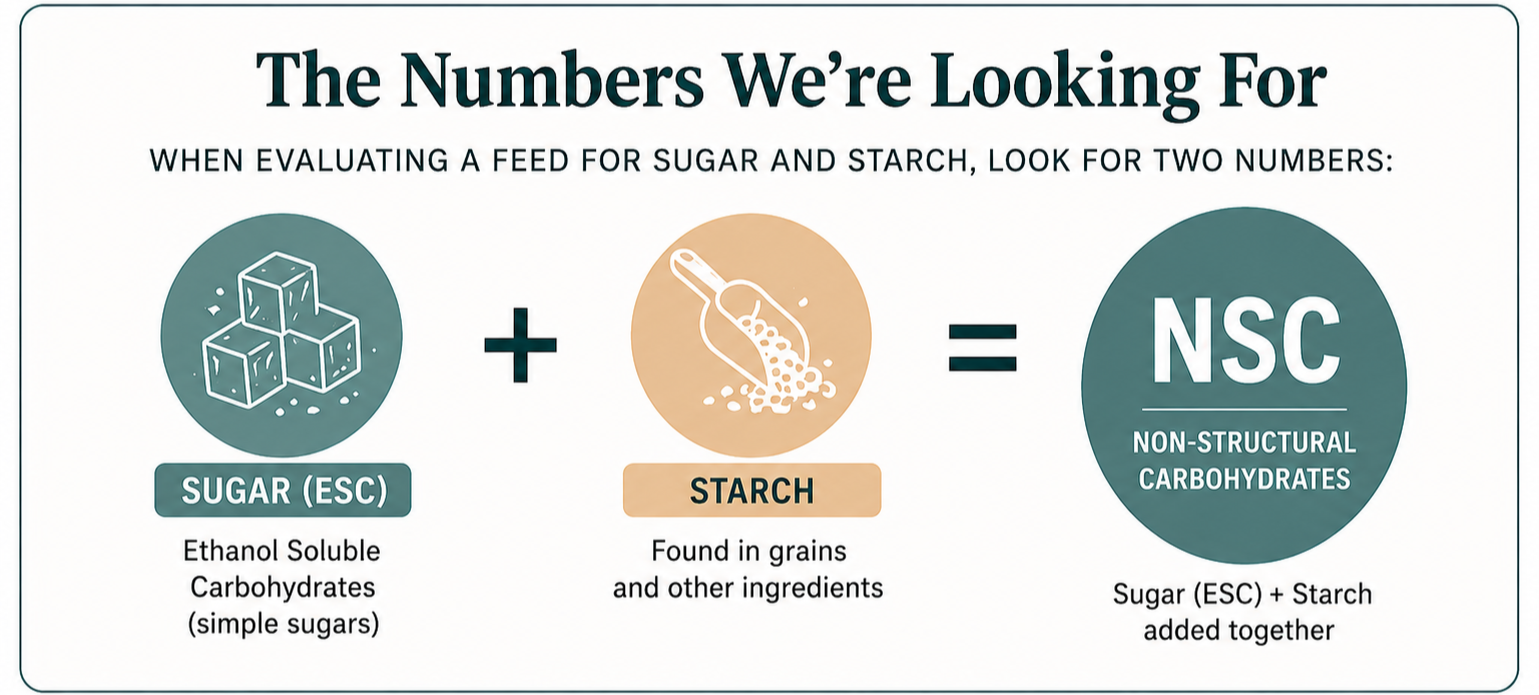
For a beginner-friendly way to compare horse feeds, we're going to focus on two numbers:
Sugar + Starch = NSC
So, if a feed lists:
Sugar: 6%
Starch: 5%
6 + 5 = 11% NSC
That's it.
Once you know where to find those two numbers, comparing feeds becomes much easier.
Don't Just Look for “Low Starch”
This is one of the easiest mistakes to make.
Let's say a feed contains:
Starch: 5%
That sounds pretty low.
But then you look at the sugar:
Sugar: 10%
Now we're looking at approximately:
10% sugar + 5% starch = 15% NSC
Looking at the starch number alone didn't give us the whole picture.
The opposite can happen too. A feed with slightly more starch may have considerably less sugar and end up lower overall.
That's why, when comparing feeds for NSC, look at both numbers.
Where Do I Find Sugar and Starch?
Flip the bag over and find the Guaranteed Analysis.
You're probably used to seeing things like:
Crude Protein
Crude Fat
Crude Fiber
Calcium
Phosphorus
Now look for Sugar and Starch.
Depending on the manufacturer, sugar may be listed as ESC (Ethanol Soluble Carbohydrates).
For our simple feed comparison, that's the sugar number we're looking for.
Example
ESC (Sugar): 5.5%
Starch: 6.0%
Add them together:
5.5 + 6 = 11.5%
That feed is approximately 11.5% sugar + starch.
What If Sugar and Starch Aren't Listed?
Don't assume they're low.
The information may simply not be included on the physical feed tag.
Check the manufacturer's website for the product's typical analysis or detailed nutritional information. Many companies provide considerably more information online than they can fit on the bag.
Another great resource for finding guarenteed analysis is MadBarn’s Feed Bank.
Now Let's Look at Some Real Feed Labels
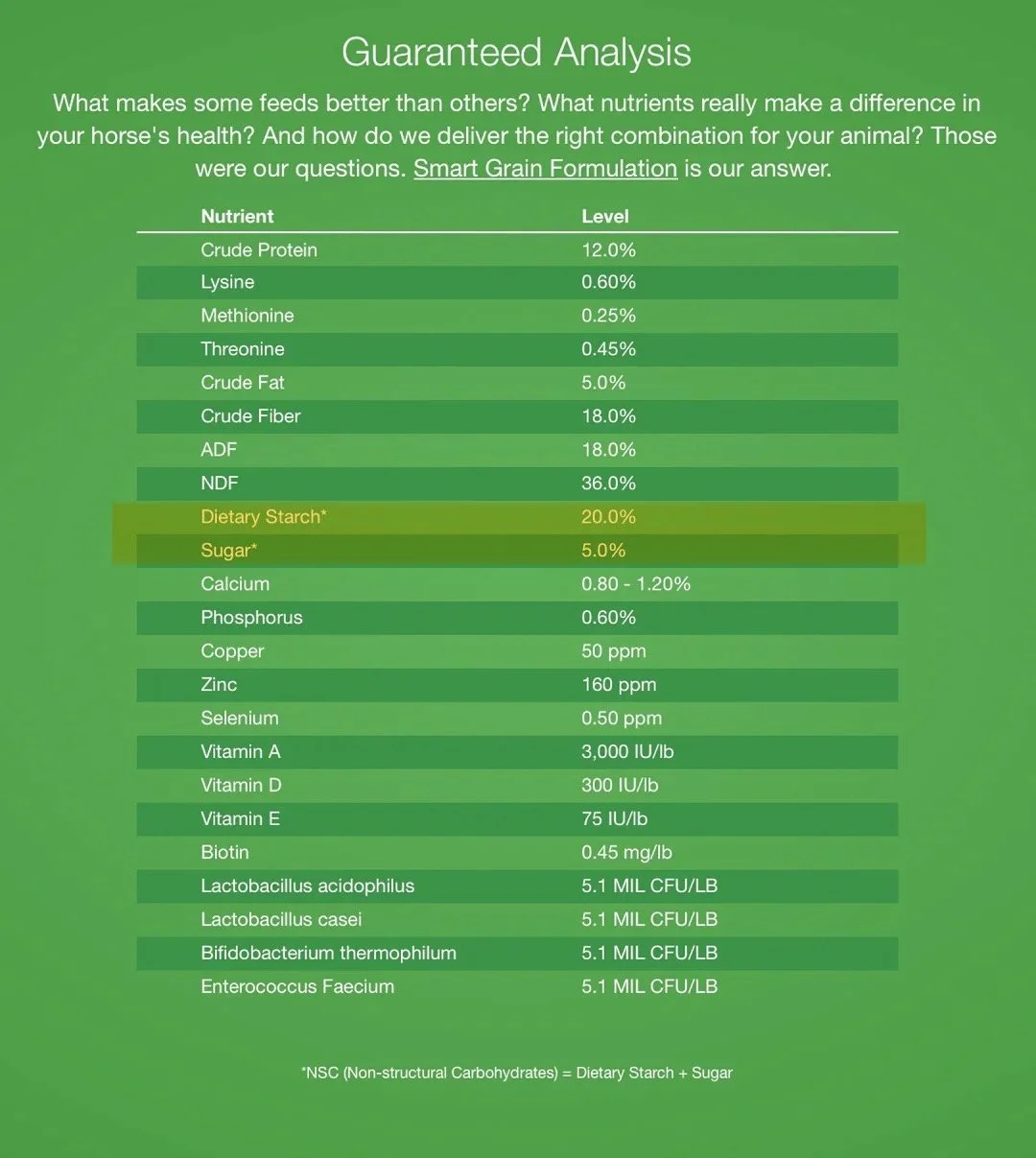
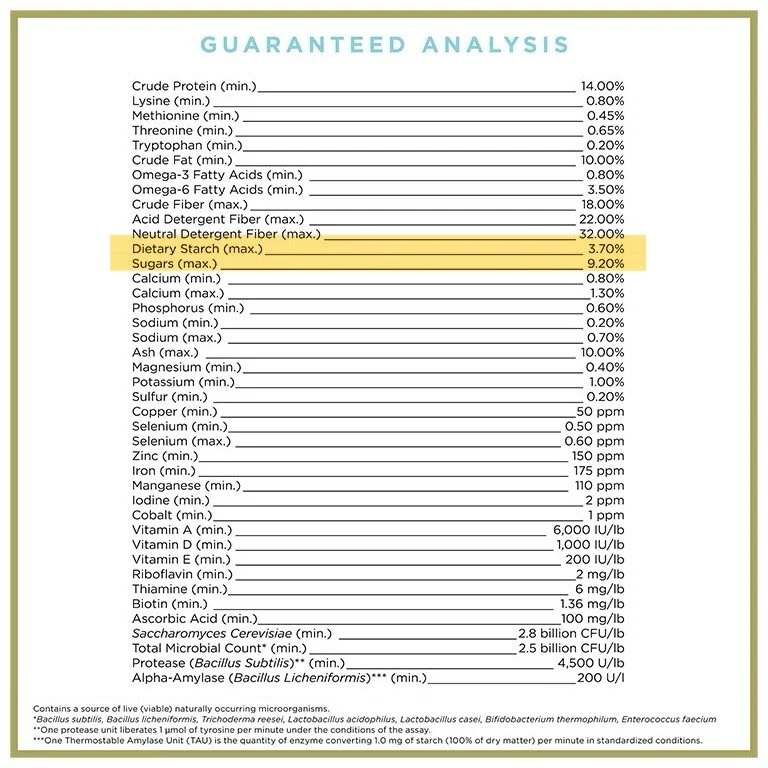
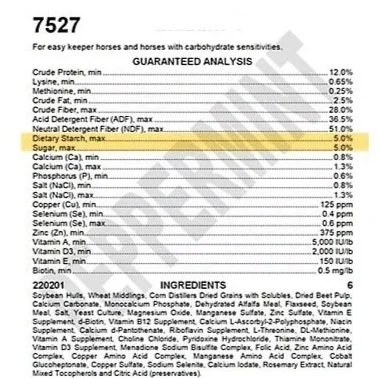
These are great examples of why I encourage owners to read past the claims on the front of the bag.
Each of these feeds is marketed using language that suggests controlled, reduced, or low sugar and/or starch.
Instead of deciding which one is lowest based on the packaging, let's actually calculate them.
For each feed:
1. Find the sugar or ESC percentage.
2. Find the starch percentage.
3. Add them together.
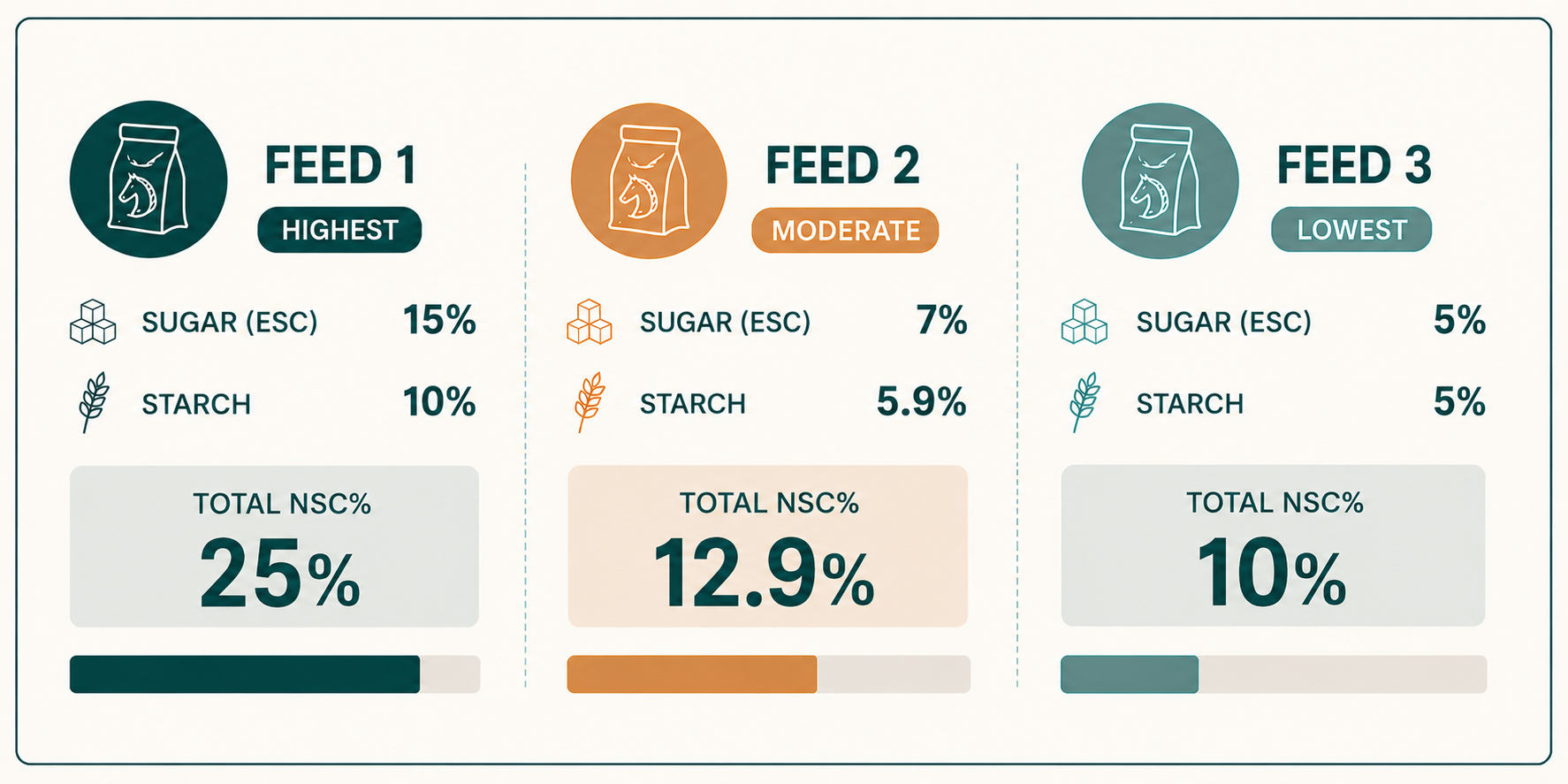
This is where the difference between marketing and reading the analysis becomes much easier to see.
Two feeds can both say “low sugar” on the bag and still have very different sugar + starch levels.
So What Percentage Is Considered Low NSC?
This is where I don't want owners getting too attached to one magic number.
You'll commonly see recommendations around 10–12% sugar + starch for horses that require carbohydrate restriction, particularly horses with insulin dysregulation or a history/risk of endocrinopathic laminitis.
But that doesn't mean every horse needs a diet below 10–12%.
A healthy horse without metabolic concerns may tolerate considerably more dietary sugar and starch. A horse with insulin dysregulation or a history of laminitis may require much tighter dietary management under veterinary guidance.
What NSC Level Should I Look For?
There isn't one perfect NSC percentage for every horse, but that doesn't mean the number doesn't matter.
For horses with insulin dysregulation or a history of endocrinopathic laminitis, controlling sugar and starch can be a critical part of management. These horses may require a carefully controlled diet developed with their veterinarian and, ideally, based on tested forage.
For horses without known metabolic concerns, I still prefer to be mindful of unnecessary sugar and starch rather than assuming higher levels are fine simply because the horse can tolerate them.
But I don't think we need to wait for a metabolic diagnosis before we start paying attention to NSC.
For horses without known metabolic concerns, the goal is still to choose a feed that meets their nutritional and energy needs without supplying unnecessary sugar and starch to do it.
In other words, a horse being able to tolerate a higher-NSC feed isn't, by itself, a reason to choose one.
For many horses, there are plenty of ways to meet those needs without relying on a high-sugar, high-starch concentrate.
And for a horse that does need additional calories or energy for performance, that doesn't automatically mean we have to stop paying attention to NSC. It simply means the entire diet needs to be considered when choosing the most appropriate energy sources.
That's why learning to read the label matters.
You don't have to wait until a horse develops a metabolic problem or experiences laminitis before you start paying attention to what's in their feed.
One More Thing: Percentage Isn't the Same as Amount Consumed
NSC percentage is a useful way to compare feeds, but there's another piece of the puzzle.
How much does the horse actually eat?
A feed that's 10% sugar + starch and fed at five pounds per day contributes more total sugar and starch than the same percentage fed at one pound per day.
That's why NSC percentage shouldn't be the only factor used to decide which feed is appropriate.
But when you're standing in the feed store trying to figure out whether that bag labeled “low sugar” is actually low in sugar and starch?
Start here:
Find the sugar.
Find the starch.
Add them together.
Don't let the front of the bag do the math for you.
Helpful Resources
ECIR Group
The Equine Cushing's and Insulin Resistance Group (ECIR) is a useful educational resource for owners managing horses with PPID, EMS, insulin dysregulation and laminitis. Their dietary recommendations include keeping combined ESC + starch below 10% for most metabolically affected horses and provide much more detailed information on managing these horses.
Mad Barn Feed Bank
Mad Barn's Feed Bank lets you search thousands of feeds, supplements, forages and ingredients and view their nutritional analyses. It's an easy resource for checking sugar, starch, and NSC when you're comparing feeds or when those values aren't clearly displayed on the bag.
Mad Barn calculates NSC in its Feed Bank using ESC + starch, which is the same calculation we've focused on in this article.
Want Help With Your Horse's Diet?
Mad Barn also offers nutrition resources and diet evaluations for horse owners.